Inspection
Substation and powerline survey.
The same corridor, flown repeatedly, close to structures. When an arm takes the contact it gets reprinted, so the aircraft is not written off.
Learn more →The Tejo is a 7-inch carbon-reinforced drone built around a single shared mounting interface. Camera, sensor, and payload modules all bolt to the same pattern, so one aircraft flies inspection, delivery, and search-and-rescue instead of three.
Camera, thermal, and sensor heads share one mount.
Bonded carbon arms swap out in the field, one part at a time.
Electronics volume reserved for autonomy from the first design.
The pack bay holds the center of gravity fixed across load outs.
An operator who needs to inspect a substation, drop a payload, and fly a search grid buys three aircraft today. Three spares chains, three sets of training, three crash budgets, even though the airframe underneath is nearly identical every time. The only thing that actually changes is what is bolted to the front.
Jing Industries builds one aircraft that carries all of it. Every part of the Tejo is a module on a common interface: the camera nosecone, the servo payload bay, the electronics tray, the tail. Frames are printed in carbon fiber reinforced nylon with bonded carbon arms, designed and manufactured in house, which means the mounting pattern stays fixed while the module library keeps growing. Adding a capability means designing one part, not one drone.
We started by publishing the airframe as design files. Builders downloaded it, printed it, and flew it, then started asking to buy finished aircraft, and asking what else the interface could carry. That demand is why we now manufacture complete airframes in house, and why the module library is the roadmap.
Today we ship airframes and design files off the shelf, and we build complete aircraft to order for defense and commercial programs. Next, complete aircraft as a standard product rather than a per-program build. After that, ground stations where the drone lands, swaps its own modules, recharges, and launches again untouched.
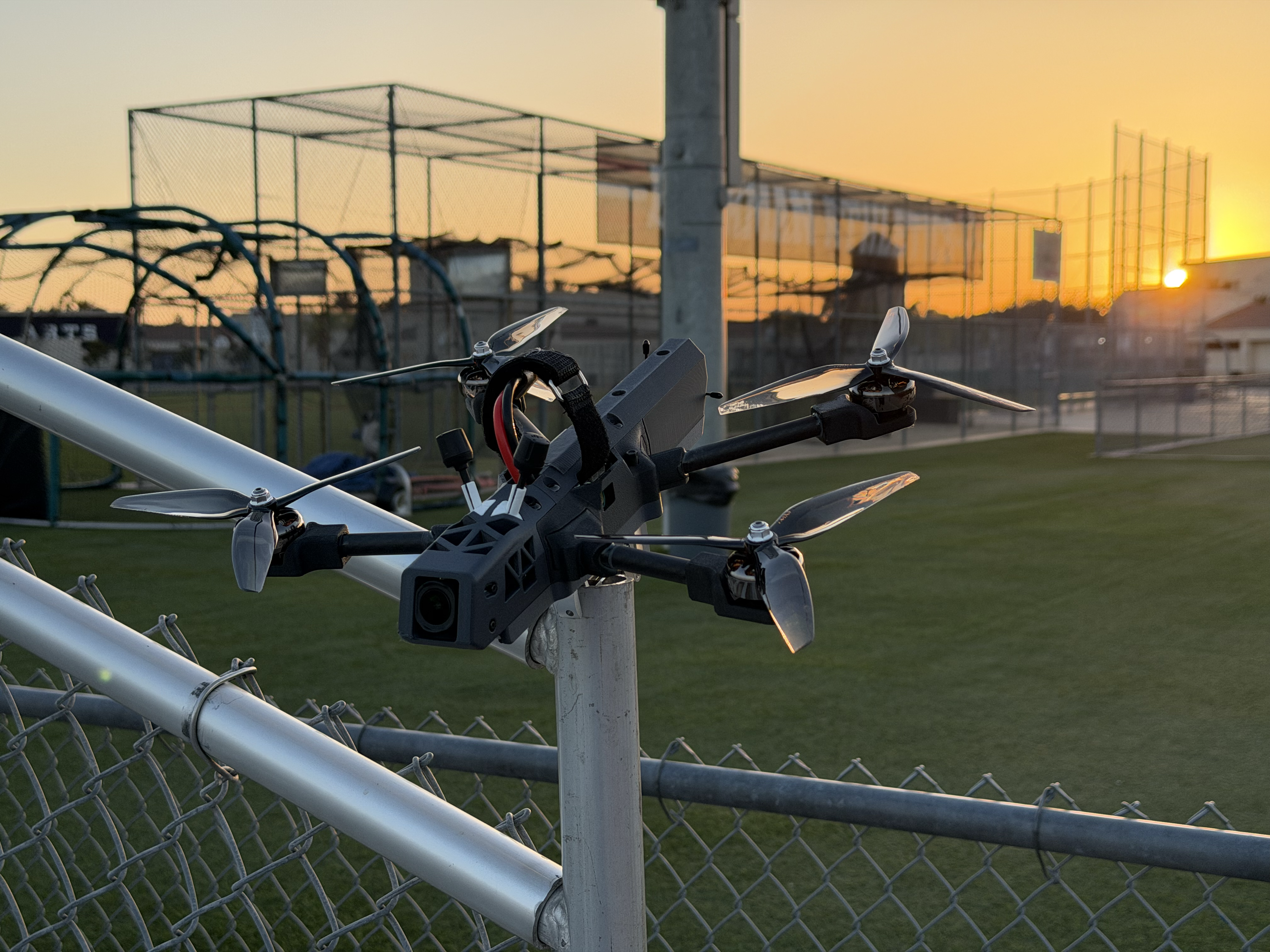
Configurations, not products. Each one is the same aircraft with a different module on the front.
Substation and powerline survey.
The same corridor, flown repeatedly, close to structures. When an arm takes the contact it gets reprinted, so the aircraft is not written off.
Learn more →Payload drop, nothing slung.
A servo dropper turns the payload bay itself into the release mechanism. The problem the airframe was built to solve first.
Learn more →Long-endurance grid patterns.
Time on station beats speed. Left empty, the payload bay buys back the flight time a grid actually needs.
Learn more →Stuck on a print, cure, or tune? Other Tejo operators share profiles and advice to get you flying.
Join the Discord